

Gosh… where do I begin with this one? As usual, let’s start with history. (Please understand that this is going to be a long post, and I cannot possibly write about all the nuances of the game.)
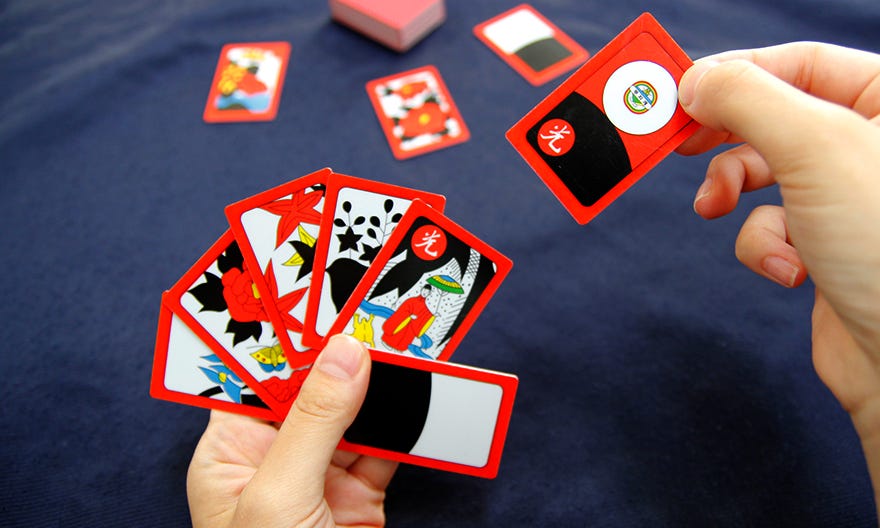
These cards are called hwa-tu (화투) and they are not of Korean origin—it’s a Koreanized version of the Japanese Hanafuda (花鬪, “battle of flowers”) cards, which themselves are Japan-ified version of Portuguese playing cards that were introduced in the 16th century.
The Japanese hanafuda cards, made by none other than Nintendo (the same Nintendo that you all know of), was brought into Korea during the Japanese occupation era about 100 years ago and has become a pastime for many and a dangerous gambling addiction for a few. But I’m not going to talk about the dark, illegal side of this gambling tool today. Rather, I’ll show you the most popular way of playing these hwa-tu cards called Go-Stop (고스톱). There are a number of different games that were all developed in Korea1 that can be played with these cards, much like the western 52-card deck.
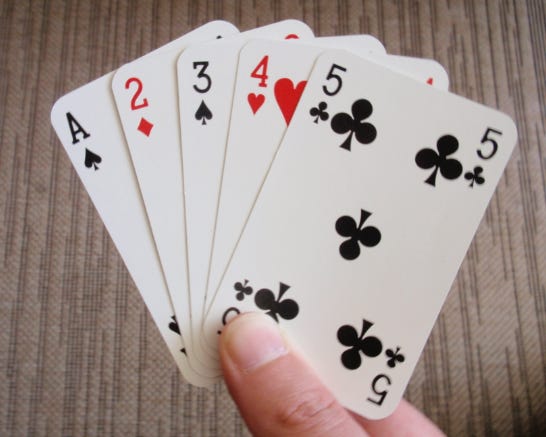
First, we have to cover the basics. There is a total of 48 cards2 = 12 “suits” X 4 cards per suit. As you can see, the cards are easy to match. They represent each month of the year, and they have their own names, but we don’t need to go into those. Besides, knowing the names of these 12 suits might make you look suspiciously like a gambler.


You need a minimum of 2 and maximum of 5 people, although 3 is the ideal number of players—it’s in fact almost always played by 3 players (although 5 people can participate, with 2 people “sitting out” each game).3
You lay out all 48 cards with face down on a thin blanket (so when you hit down on it, the cards don’t bounce up). Each player will randomly choose a card and open it. Whoever picks a higher month card (refer above) will be the initial dealer. If two people pick the same suited cards, the person who picked the “higher value” card4 will be the dealer.
Being the dealer doesn’t mean much in hwa-tu games—you get to shuffle the cards, deal the cards, and go first. That’s it. And whoever wins the game will be the dealer the next game, and so on.
** To simplify the description, everything I describe here will be based on a 3-player setup.
The dealer shuffles the cards and will have the player sitting immediately to his/her left cut the cards, like this.
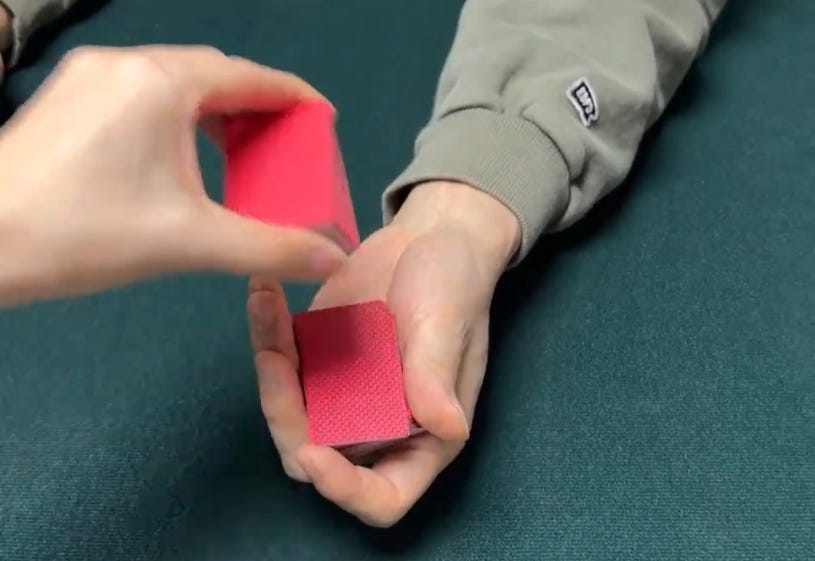
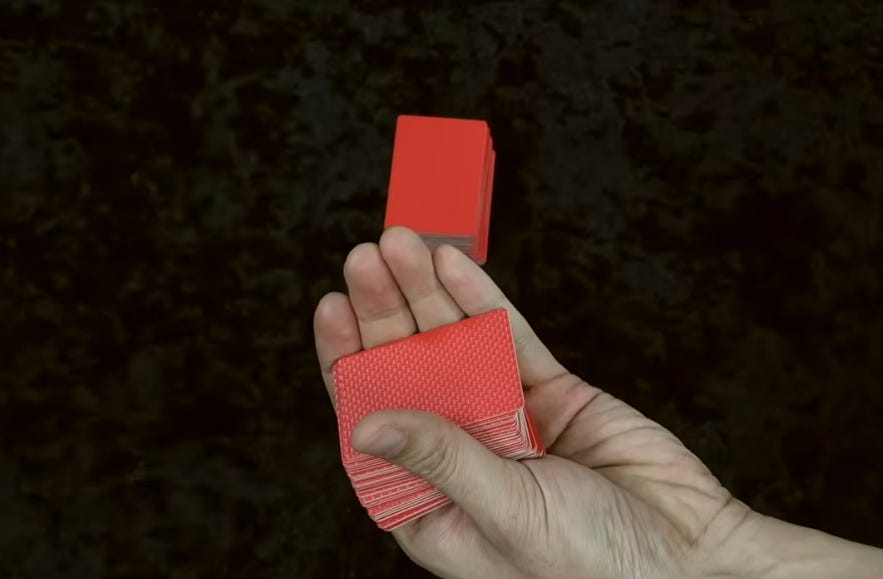
The cut cards are left face down in the middle like this.
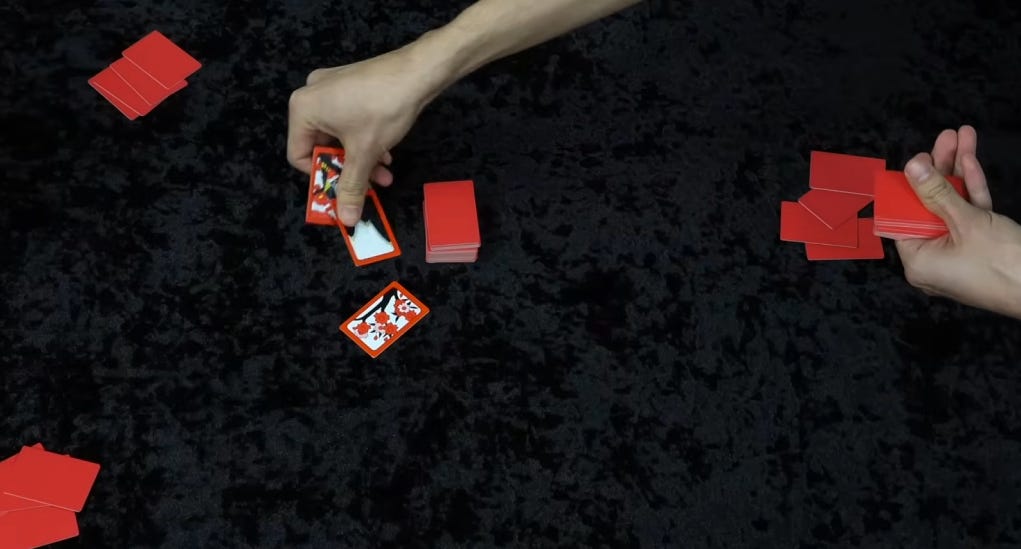
With the cards left, the dealer will pass out 4 cards face down to each player and lay down 3 cards face up on the blanket/table.
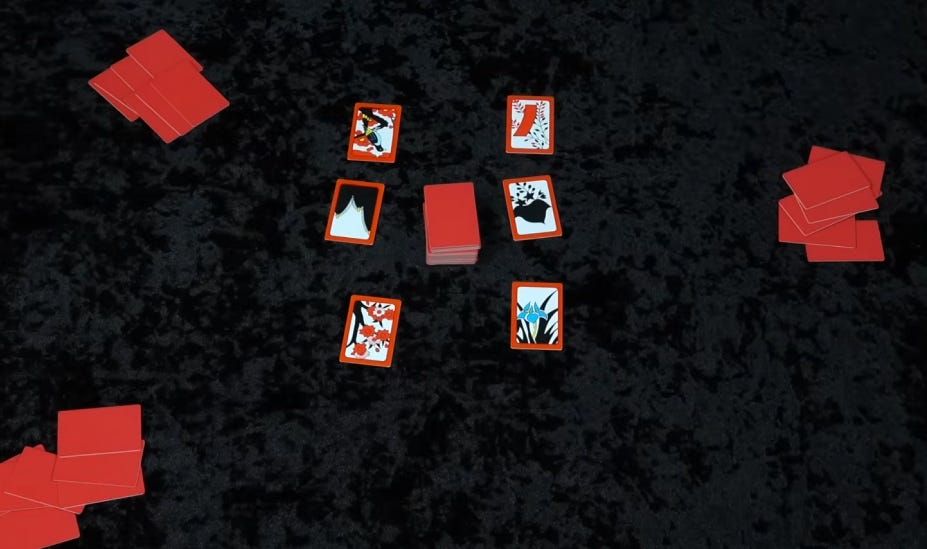
Then the dealer will deal additional 3 cards face down to each player, for a total of 7 cards, and lay down 3 more cards face up. This is the most basic set up. 7 dealt cards to each player, 6 initial cards to play with facing up, and the middle deck that was cut.
As the dealer, if you run out of cards when dealing them, you just grab more from the middle deck. If you have cards left after dealing them, put the leftover cards on top of the middle deck.
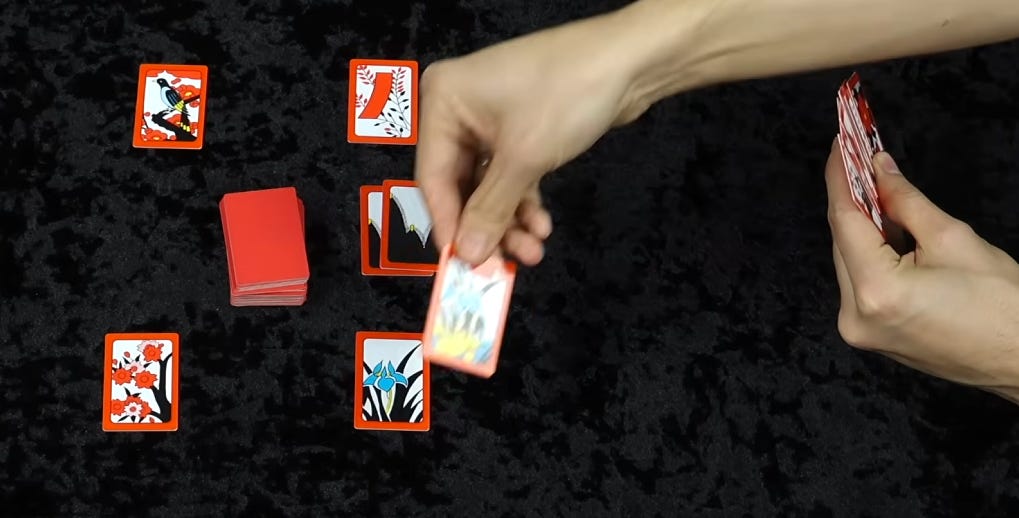
The dealer goes first, and counterclockwise (to be technically more accurate, to the right of the dealer). If the dealer has in his/her hand a matching card with any of the 6 cards on the blanket/table, he/she will take that card and…
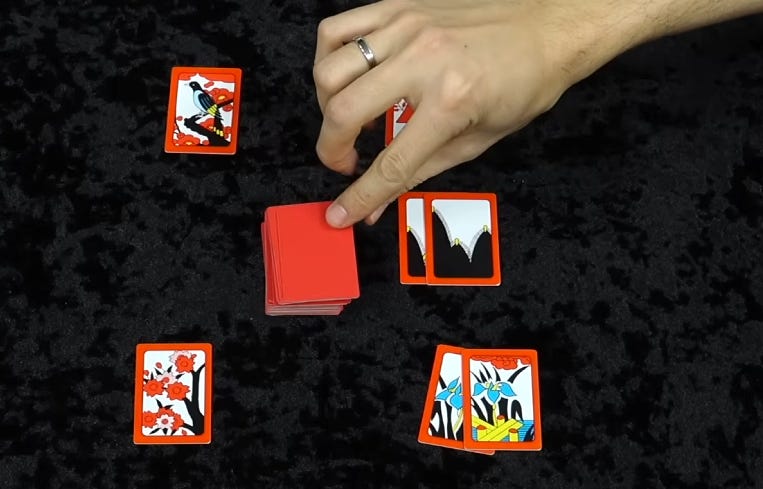
… take the top card from the middle deck and open it. If there’s a matching card, you take them too. If not, then you simply lay it down on the blanket/table.
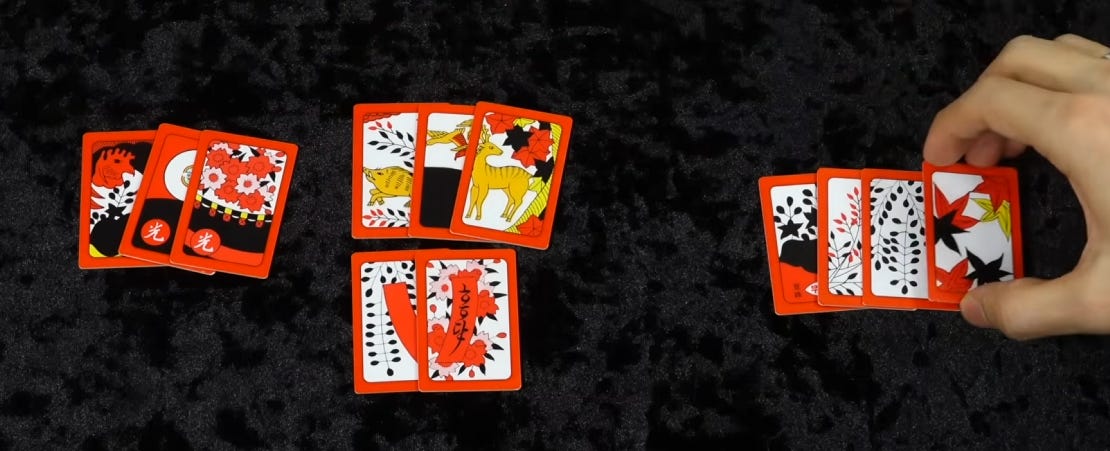
While the game is going on and you’re collecting cards, this is how you arrange them. The terminology description will follow—the Gwangs on the left, the “10s” (끗) cards on the top middle, the “stripe” cards on the bottom middle, and the pih cards on the right—this is all to make point calculations easier, and to have other players see what you’ve gotten for strategy purpose.
** The following is a YouTube tutorial on how to play Go-Stop in Korean. You can change the language settings, I think. This is probably the best tutorial video I’ve seen.
The ultimate goal is to accumulate as many points as possible, but once you accrue 3 points (there are many ways to achieve this), you can either “Stop” the game or continue to “Go” to earn more points—hence the name Go-Stop.
This is a zero-sum game. You can establish the rules however you like, but to give you a guideline, I taught my dormmates in college how to play and we used to do 1 penny per 1 point. The maximum you could lose was about 1 dollar and by extension, the maximum you could win was 2 dollars. No big whoop.
** At this point, it would be prudent for me to tell you that there are at least five Go-Stop apps on either Android or iPhones, all free, that you can download and play.
So, here’s the list of the ways you can “earn points.” You might not realize it as you’re learning how to play but there is literally a million different ways to win the game and because of it, so much strategy involved.
The 광s.
These are the five “광 (gwang, “light, shine, or bright”)” cards. You’ll notice that these are the only cards that have the Chinese “光 (gwang)” letter printed on them.

Any combination of 3 of these 광 cards is worth 3 points. Except!! When one of the 3 cards is the last one (called 비광 “Rain Gwang”), it’s worth 2 points. When you only have 1 or 2 of these 광 cards, it’s not worth anything. If you get any combination of 4, it’s 4 points, and if you happen to get all 5, it’s worth 15 points (very hard to do).
** Strategy point: you might have to try to get at least one only to break up other people’s Gwang points. Besides, if you don’t have any, you may have to pay double at the end of the game. It’s like a penalty for not getting any—but if you end up winning the game anyway, this is moot of course.
고도리 (Godori, or “Five Birds”)

If you get only one or two of these cards, it’s not worth anything—you have to get all 3 and it’s 5 points. “고도리” is Korean transliteration of the Japanese word that means “Five Birds,” which is self-explanatory.
The 끗s (or, the “10s”)
These 9 cards were the reason why I wanted to write about the Min-hwa-tu (민화투) game first but that game is way too simple, not much of a strategy involved, and there is no app on the phones.

Basically what we call the “10s (min-hwa-tu term)” and they all have some sort of animal on it, except the two cards on the right, top row.
Other than the above godori (5 points), any combination of…
5 cards = 1 point,
6 cards = 2 points,
7 cards = 3 points and so on.
What if you have 5 cards that include the 3 godori cards? 5 + 1 point = 6 total points.
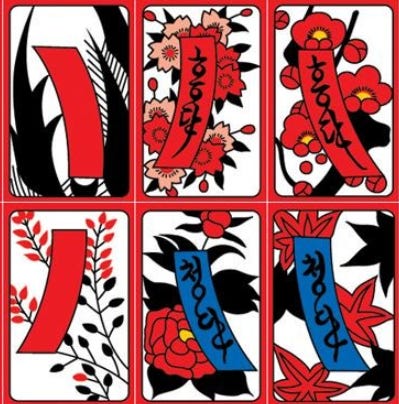
홍단, 청단, 초단 (Hongdan, Cheongdan, Chodan, “Red Stripes, Blue Stripes, Plant Stripes”)
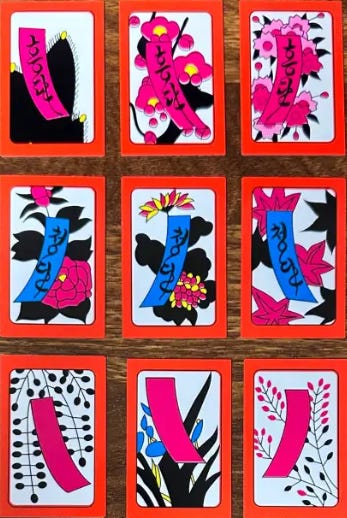
If you get all three of the same stripes, whether they be hong, cheong, or cho, it’s worth 3 points. One or two means nothing. But just like the 끗 cards above, when you get any combination of…
5 cards = 1 point,
6 cards = 2 points,
7 cards = 3 points and so on.
If you’ve taken 3 hongdan + 3 cheongdan cards, that means = 3 points + 3 points + 2 extra points (because you have 6 “stripe” cards in total) = 8 points. There is one more “stripe” card that doesn’t belong anywhere. But it still can be useful.

피 (pih, “Shell, Bark, Outer Cover”)
Notice that basically half of the 48 cards (2 cards on the right of each suit, above) are bare— without any stripes, or Gwang, or animals.
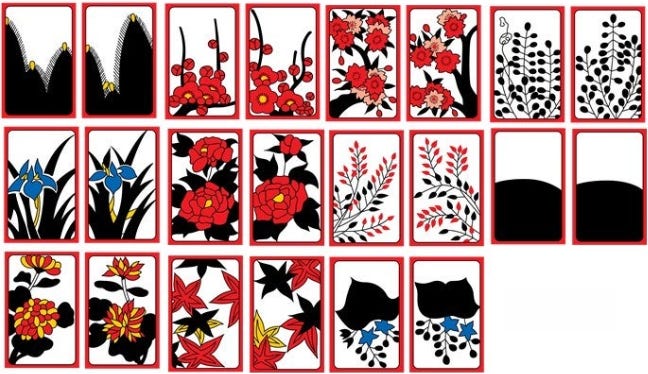
These again aren’t worth anything, until you get
10 cards = 1 point,
11 cards = 2 points,
12 cards = 3 points and so on.
The Double 피
There are three 피 cards that are counted as double.

That first card can be a 끗 (“10s”) card or used as a double 피 card, whichever to your advantage. 90% of the time, it is used as a double 피.
The Pitfalls and Other Details
Okay, so I was playing the Go-Stop game on my Android phone app to see if I can save a screenshot to explain things for you (what I do for my readers…). I can explain 4 different things that can happen with this one screen. So, let’s get to it.
** The setup here is different from what I described above because the phone app games are played one-on-one, not 3 players. On the phone apps, you get dealt 10 cards and there are 8 cards facing up on the table.
You can see my 10 cards at the bottom of the screen. And obviously the computer’s hand at the top of the screen is not shown.
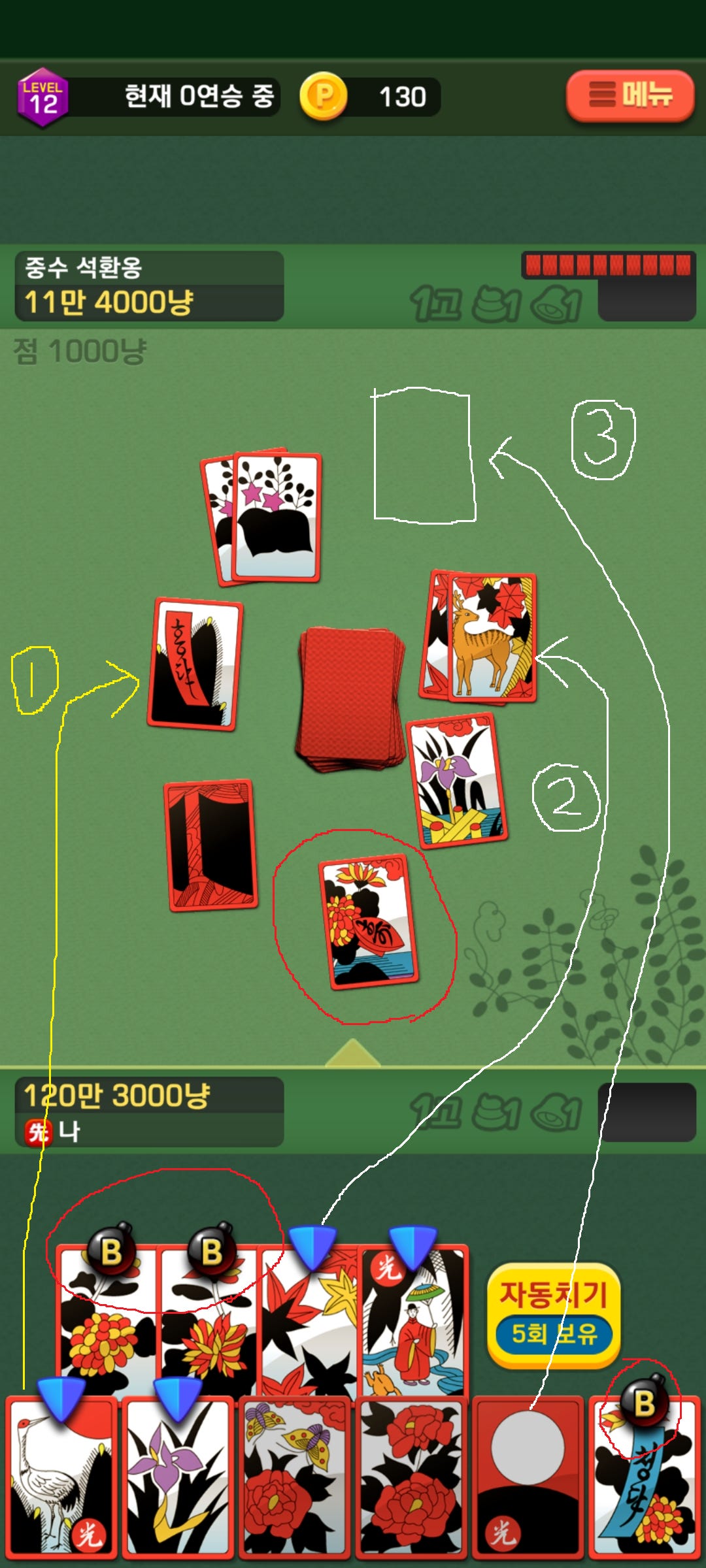
Of the 10 cards, do you see the 3 cards of the same suit, marked with red circled B? That B is short for Bomb or 폭탄 (“bomb” in Korean, literally). Whenever you have three cards of the same suit, you can show it to other players (called “흔들어”) before the game starts. If you happen to win the game, you get paid double because this is considered a bad hand—it is always beneficial during a Go-Stop game to have as many different suit cards as possible. And when you play the “B”omb card, and bring in all 4 cards of the same suit in one shot, other players have to give you an extra pih card (potentially 2 extra points).
The yellow number 1 card. Say you decide to play that “January” month Gwang card to get the same suited hongdan card. When you flip the top face-down middle deck card, and if the same suit card comes up, then (sigh… be careful about the pronunciation but…) 뻑5 just happened. Or, you just 똥 쌌다 (= crapped). When this happens, you cannot take those cards. All three are left on the table on top of one another. Anyone who has that fourth card of the same suit will end up taking all four cards—and as a bonus, you get another pih card from both players (potentially 2 extra points).
The white number 2 card. There are two same-suited cards that you can take with that October month pih card that you have. You will have to choose one that’s potentially more beneficial to your situation. But!! If you play that card, and when the face-down card from the middle stack happens to be the same suited card—so that you take all four cards in one turn, that’s called 따닥 (onomatopoeia) and again, other players have to give you a pih card that they have (potentially 2 extra points).
The white number 3 card. Say that there is no matching card for that August month Gwang card and there is nothing else that you can take from the hand that you have. So, you decide to lay down that card and flip the face-down card from the middle deck to reveal the same-suited card! And you end up taking it back in the same turn. That’s called 쪽 (another onomatopoeia that represents “kiss”), and the other two players have to give up a pih card (potentially 2 extra points).
In summary, any combination of the points that I described here can be added. For instance, if you have 1 point from having any combination of 5 “10s” cards, 1 point from having any combination of 5 “stripe” cards, and 1 point from having any combination of 10 pih cards = then you have 3 points.
Quiz. How many points do we have here?

+
+
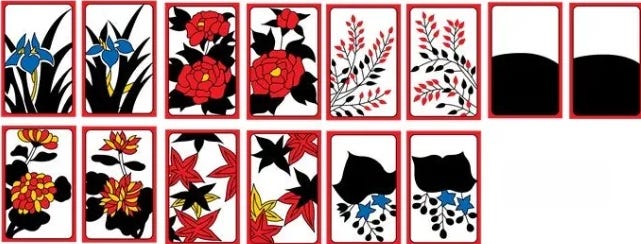
If you’ve collected all these cards, this would be 9 points, plus alpha (explanation to follow, if you decided to “Go” after the initial 3 points).
Therefore, there is no such thing as “worthless” cards in the Go-Stop game. So, when you have accumulated 3 points before anyone else, you can “Stop” the game, no matter how many cards you still hold in your hands. Theoretically, a game can be won with 3 or more points with just 2 go-arounds, and it does happen.
But the real gamesmanship starts when you have the 3 points and have to decide whether to “Go” or “Stop.” If you “Stop,” then you get paid 3 pennies (or quarters or dollars) from the other 2 players and you move on to the next game. But, if you think the other two players have no shot at getting to the 3-point level in the next couple of turns, then you can “Go.” All you need to do is grab another point—by getting just 1 more of the pih cards or any other card that will give you that extra point. When you do, you can again decide to “Stop” or even “Go” further, again and again. Each “Go” adds an extra point to your total point tally. And if you “Go”-ed three times and still won the game, then your point total is doubled.
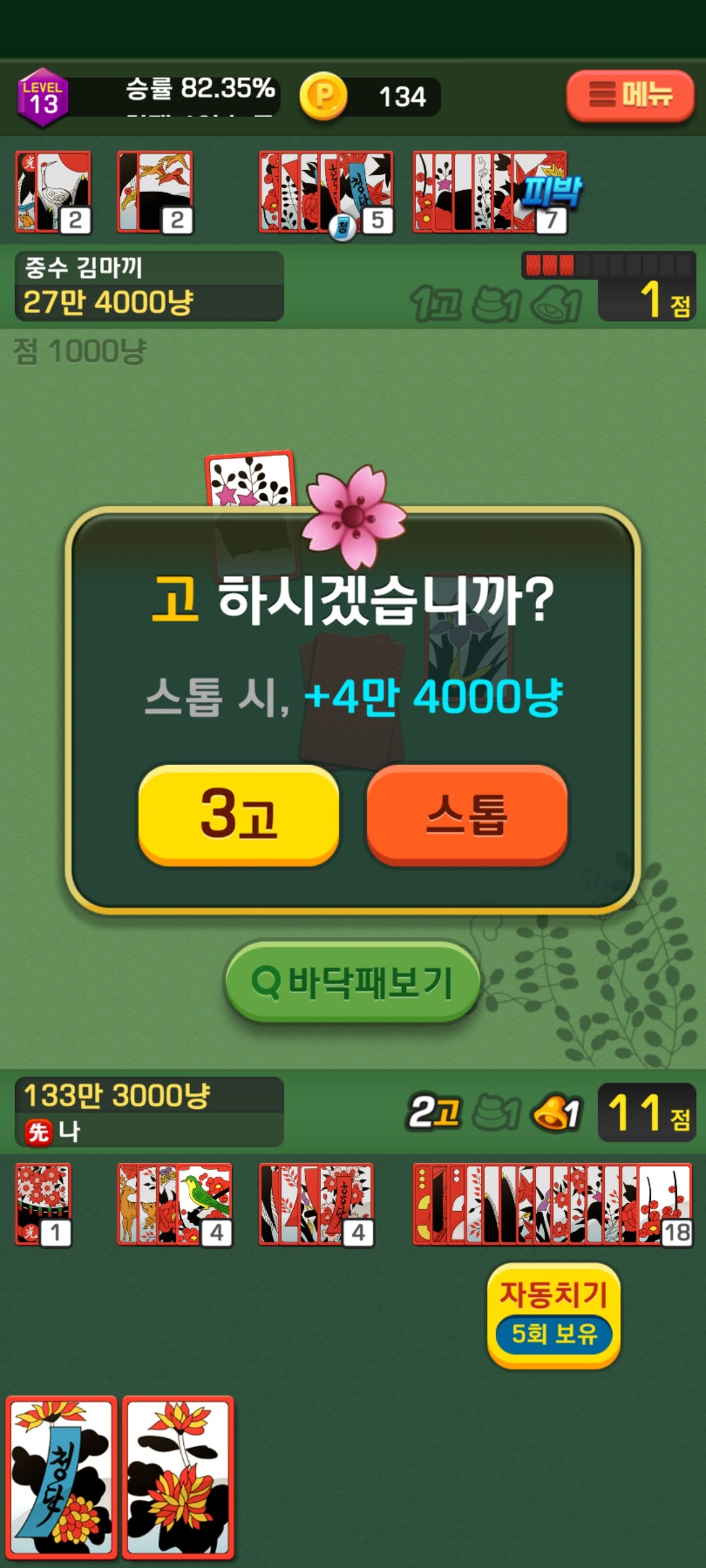
But here is the catch. If you “Go”-ed and someone else unexpectedly got 3 points before your next turn, then you have to cover the losses for two people. It is thus only natural for the 2 people to “work together” to stop the person who keeps “Go”-ing. And you have to be really careful because of all the pitfalls of what can happen that I talked about—they can really turn the game upside down with one bad (or good) move.
In the above screenshot, I clicked on the yellow “3고” button, thinking that there was no way the computer with 1 point could get to the 7-point mark in the next two turns. Well, guess what. I ended up losing the game because of the “pitfalls” I wrote about actually happened—two times in a row.
The game really does make you think and do quick calculations on the spot. It is no wonder why so many of the older folks play it at senior centers. First, it gives them something to do. Second, it keeps them social. Third, it keeps your brain muscles working. Korean doctors have said, reluctantly so because of the gambling nature, that it actually might help prevent Alzheimer’s.
All Koreans know a form of hwa-tu game but in Japan they don’t play with these cards anymore. If so, very rarely.
There are actually 1 to 3 more “joker” cards but we’re not going to concern ourselves with those. And different manufacturers have different number of cards with different designs.
Slightly complicated, maybe for some other time.
The card on the left of the same suit is of “higher value” but that’s not necessarily what that means in Go Stop game. The
This is a Korean slang word that has nothing to do with the English word “f*^k.”
This sounds hard!