
Geographical & Geological Features of Korea

I think it was my third year in college when I had to take an East Asian history class as a part of my General Education requirement. The professor was this tall man with a ponytail (during the late 80s it wasn’t all that common) who had a Caucasian last name but with Asian facial features. It turned out that his mother was Japanese, and that he used to teach Japanese history at the University of Tokyo!
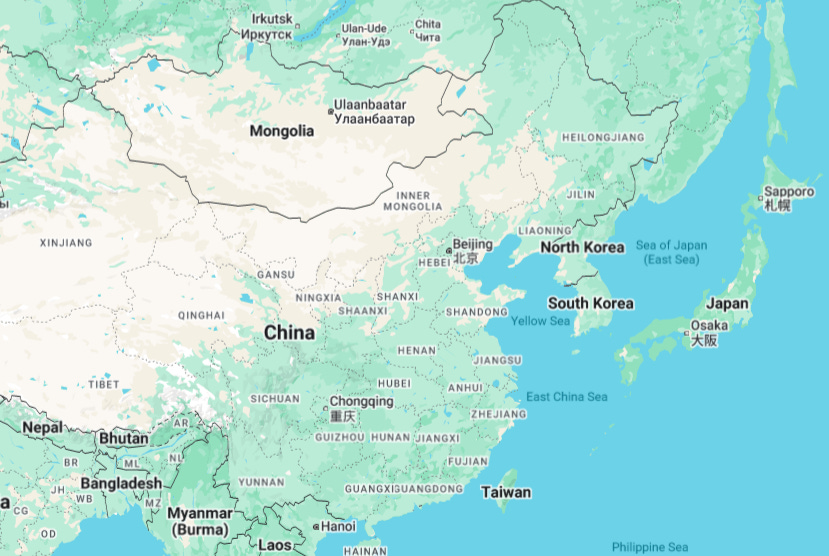
During one of the lectures, he pulled out this giant map of East Asia and asked us to look closely at how Korea is positioned relative to the shape of China and Japan.
Huh? The shape? This is new. I thought. What followed came as utter shock to me, and probably to other Korean students in the class too. The professor went on to explain that the reason why Korea was invaded by China and Japan so many times over two millennia was because…
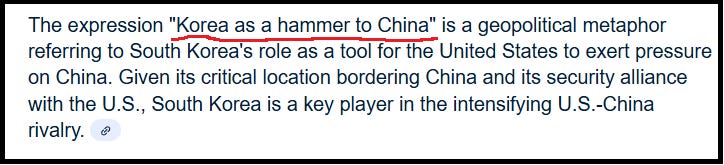
Korea looks like a hammer that’s ready to strike the back of China’s head, and Korea looks like a knife blade ready to stab at the belly of Japan.
Honestly, I don’t know to this day where this came from because no Korean is ever taught this. Was it the professor’s personal opinion? (I doubt it.) Did it come from some obscure Chinese/Japanese document justifying invasion of Korea?
Maybe I just wasn’t paying close enough attention.
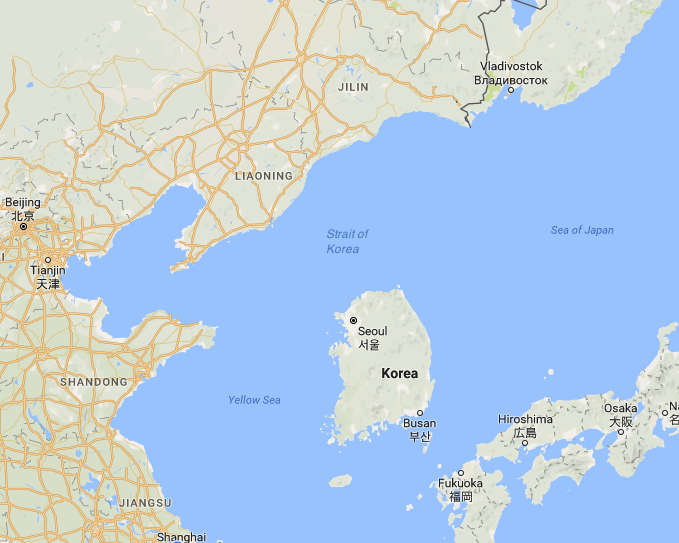
This is a slightly different way of looking at the geographical position of South Korea. You can’t travel or pass through North Korea through ground transportation—S. Korea therefore is effectively an island country.
It is also historically in a very precarious position, as three of the world’s superpowers are its immediate neighbors. Japan to the east, China to the north and west, and of course Soviet Union/Russia to the far north (but sharing borders with North Korea). Not to mention the menace and a joke of a country to the immediate north.
But purely from the United States perspective, South Korea is in a perfect location as a buffer state to protect its prime American interest (= Japan, and increasingly Taiwan which is a 2-hour flight away) in East Asia. It is imperative, from the American point of view, that South Korea and Japan maintain a good relationship, but that’s not been so easy because of the history between the two.
This is a topographic map of the Korean peninsula. As you can see, the eastern part of the land is very mountainous and rough, from all the way up from northeastern corner down to the southern coast.
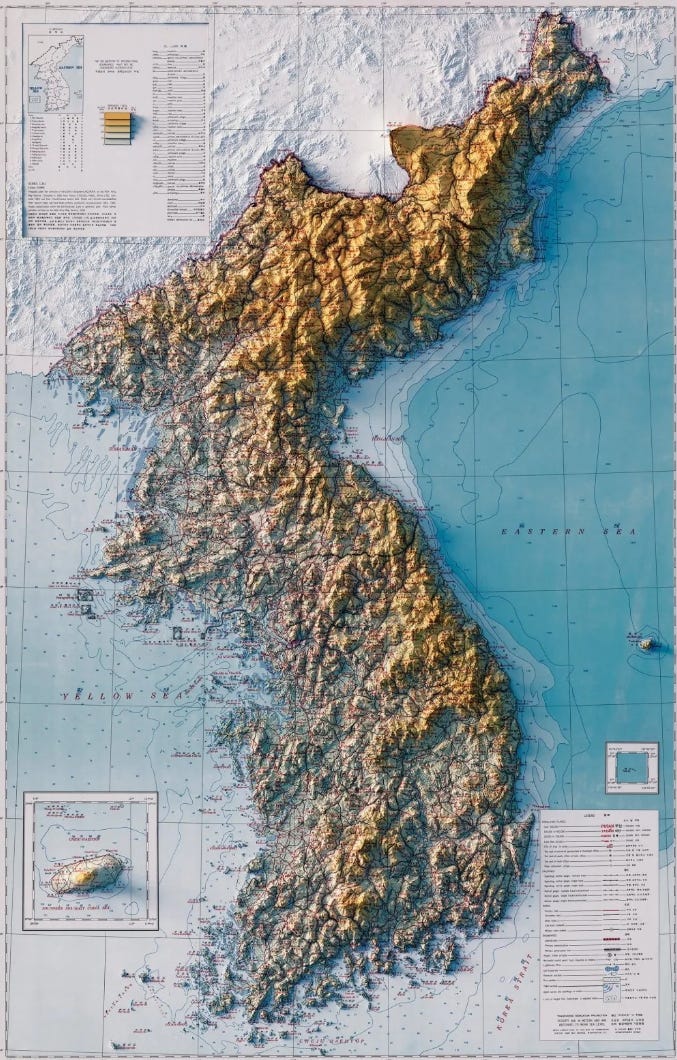
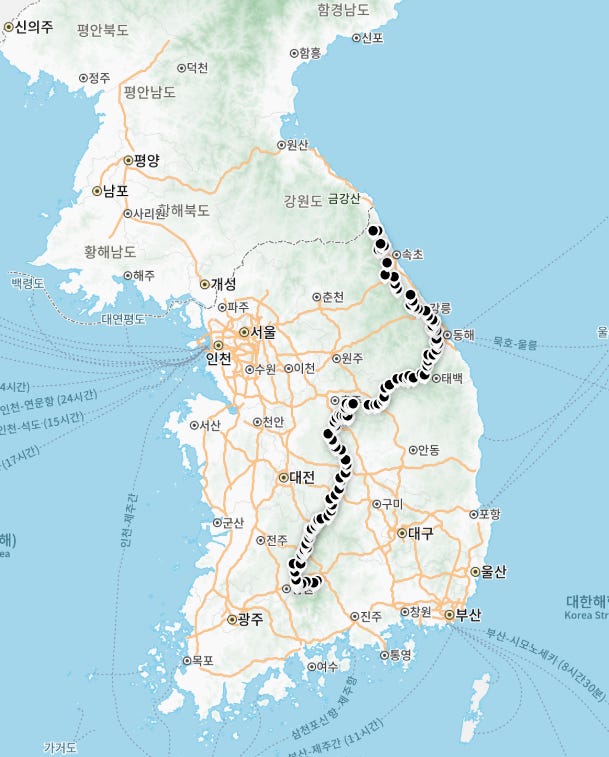
This long mountain range is called 백두대간 (baekdoo-daegan). And for the (super) well-conditioned and intrepid souls, there is this trekking course that spans basically all of South Korea.
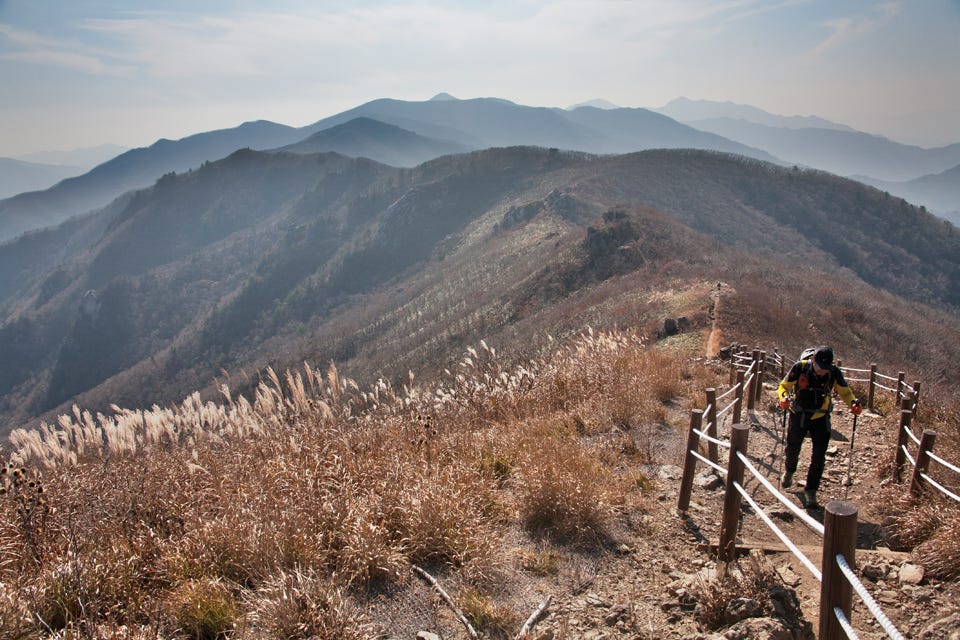
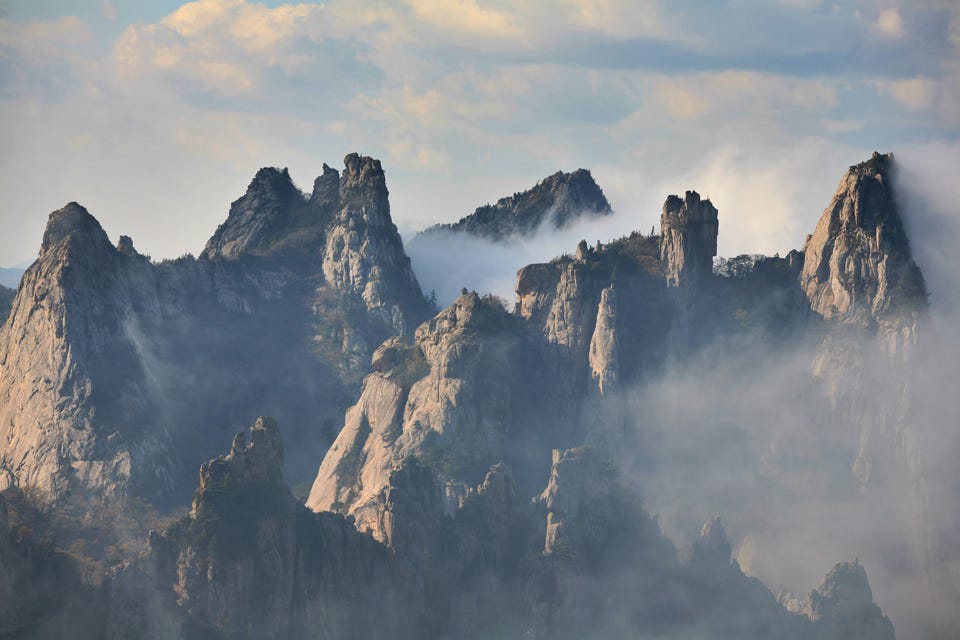
One day (soon, I hope), this trekking course will continue up north to the far corner of the peninsula to the delight of hikers worldwide. Mt. Gumgang (금강산), only 15 miles north from the north-south border, is supposed to be absolutely gorgeous.

Granite is one of the hardest stones out there. What this number means, coupled with the fact that about 70% of the country is mountainous, only about 13% of the land, and decreasing every year, is arable. And most of these 13% of the land that can grow crops (rice taking up about half of that 13%) is in the southwestern region of the country (Jeolla Provinces).
But on the other side of the coin, having a lot of granite in a mountainous country has a positive impact on the natural water quality.
First, granite is resistant to corrosion and erosion, so its components do not dissolve easily in water, and the sandy soil formed by weathering granite acts as a kind of “filter” that can naturally and reliably remove pollutants from water.
Second, country is small and has a lot of mountains. This means that rivers are relatively short and have fast currents; most of the natural debris/pollutants are washed into the ocean before they’re deposited into the local rivers and water supply.

The mudflats called 갯벌 or 뻘 of the Korean west coast is a boon for all kinds of sea life. One of the delicacies to the Korean palate, but one of the hateful foods for the uninitiated, nakji (낙지, indigenous Korean small octopus) lives here. So do all kinds of mollusk.
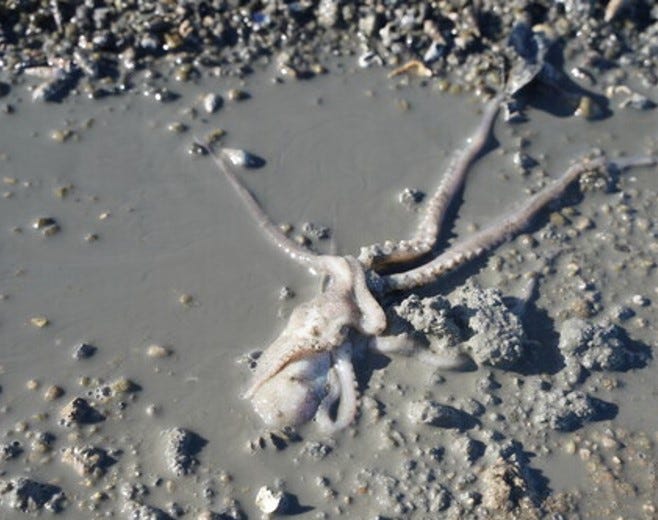
This doesn’t look like much, but it is a very rare geological formation. There’re only a handful of these mudflats around the globe—northern Europe, east coasts of Canada and the US, the Amazon, and of course the Korean west coast.
The forming of mudflats requires a set of specific conditions over a very long period of time—coastal area where outflowing river(s) deposit soil, that is relatively flat (hence the name), there are low churning waves, and the tidal range is very large.

The city of Boryeong (보령) attracts over a million visitors (feels like there’re more foreign visitors than Korean natives) during its “Mud Festival” every summer.
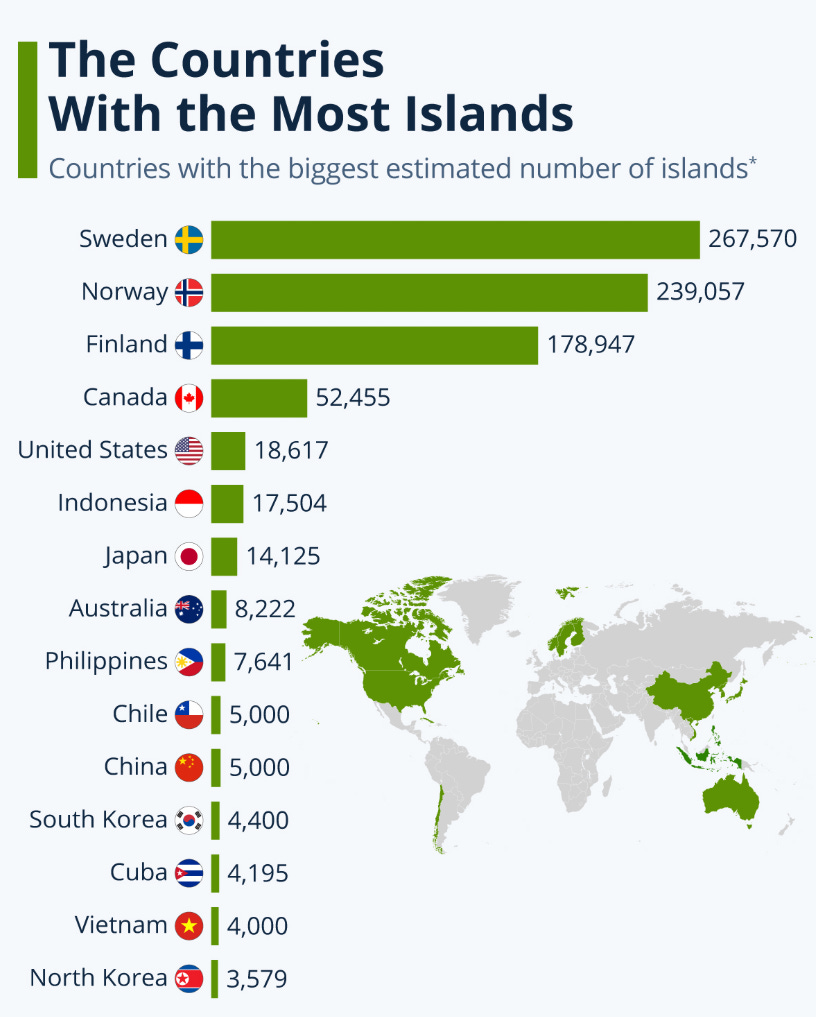
The Korean peninsula (South + North) has almost 8,000 islands, which ranks it 9th most in the world, and for a small country at that.

Of the 4,400 islands in South Korea, the city of Tongyoung (통영), which is near Busan, has about 500 by itself—most of them are obviously not shown in this map.
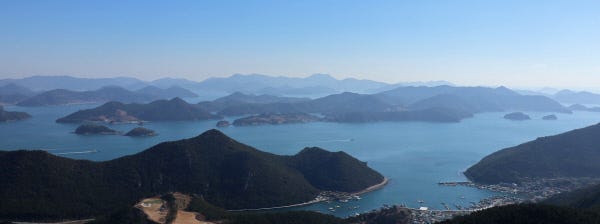
Because these small islands all work as natural breakwaters (= seawalls), there are many pockets of the sea that’s very calm, and the temperature year-round stays constant between 15~20 degrees Celsius (60~70 in F).
What it also has are a few nearby big and small rivers that dump out to the sea. The convergence of the fresh water with ocean water makes the Tongyoung teeming with nutrients and phytoplankton in its waters.
All of these factors make Tongyoung “the capital of oyster farming.” South Korea probably has the least expensive oysters in the world that are coveted by many (I’m not fond of oysters, btw).
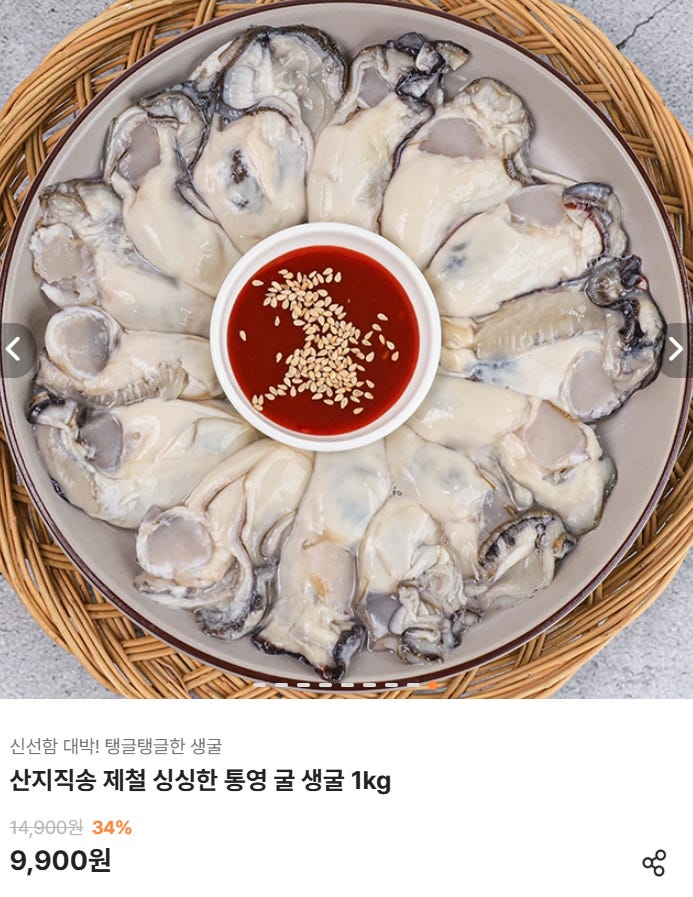
1 kilogram (= 2.2 pounds) of shelled Tongyoung oysters at 9,900 KRW (= $7.25 USD).
One of the TV shows I watch regularly went to an oyster specialty restaurant in Tongyoung. The video starts at 7:26 mark where the food comes out.
A milk cart full of oysters, abalone, and scallops that will feed 5 adults for 65,000 KRW (= $47 USD). The two Koreans in the video are the hosts of the show and the three guests, all fluent in Korean, are Alberto from Italy, Daniel from Germany, and Lucky from India. Alberto says that the amount of oysters served in the video would cost 1 million KRW (~ $725 USD) in Italy.
I am going to have to eat more Oysters. Busan is an amazing seafood destination.
Nice essay! I enjoyed reading it (and learned some things :-))